Kamakura Report #7 "From Sydney to Kamakura", "Shonandaira湘南平-Komayama高麗山" Saturday April 30, "Sakashita Dam, Okuma-Machi, Futaba-gun" Wednesday May 4”
"From Sydney to Kamakura"
We had to delay our departure to Japan for 2 weeks, due to the infection of Covit-19.
[A part of daily trekking course, 日々のトレッキングコース、매일 트레킹 코스]
Since the wedding of our first granddaughter, Naomi, was successfully completed on 26 February, we decided to return to Japan for the first time in three years and purchased tickets from Sydney on April 7.
Unfortunately, I got infected with the virus on 3rd April. I felt a slight headache and sour throat that day.
However, I thought I recovered on Monday because I had no symptom on the day of the test.
[Monstera flower along the daily route,日々の散策路脇に咲くモンステラの花、몬스테라의 꽃]
On April 6, we were shocked to find out the result of PCR. It was“POSITVE!”
My wife had no symptom until the day of the test. But she began to feel a mild cold symptom such as a sore throat.
When she consulted with her GP, she was prescribed "Panadol." She had no fever.
[At Fandale Park (neighborhood), 近所のファンデール公園、동네 판데일 공원]
In Sydney, there are many drive-through test places where people get PCR test.
However, there is a charge for requesting a negative certificate for travel.
We used the Pathologist introduced by my GP and paid $ 150 per person.
In Sydney, it is possible to use a commercially available RAT kit, which is easier than the PCR test.
The RAT test is easy, so the next week, when I checked with RAT kit by myself, the result was negative.
However, my wife was positive again.
Both were negative on the RAT test on Wednesday morning, April 11, within 48 hours of departure.
We took PCR tests, but the results were hard to come by. No results were obtained at 9 pm on Thursday, April 12, 24 hours before departure, and 3 hours later, "POSITOVE" results were informed by SNS.
Flight tickets can be changeable if we ask for, more than 24 hours before boarding, but at that point, it was too late.
A week later, I learned from word-of-mouth that an agent to issue certificate by the cost of A$ 79.
First, we had free PCR tests 74 hours before the boarding to confirm that we were "negative," then we took fee-charging PCR tests 48 hours before the boarding.
Finally, we got "negative certificate" this time. After all, two weeks later than originally planned, we left Sydney on April 21 and arrived at Haneda on April 22.
In Haneda, PCR tests are also required after arrival, and only if the result is negative, you can enter the country without quarantine.
In Sydney they use sample while rubbing the oral cavity and nasal cavity. But in Haneda, they use saliva for the sample for PCR tests.
Due to my chronic diabetes, it was hard to produce enough saliva for me. After struggling to produce saliva I gave up and went the last person of the line where people use the same method in Sydney (most children were under this category.)
We were finally released 3 hours later after our arrival, but we faced another problem with transportation to go home.
The number of direct buses from Haneda Airport to Ofuna was too small, so we had no choice but to take a taxi to our house. The charge was 14,500 yen.
"Shonandaira湘南平-Komayama高麗山" Saturday, April 30
The first hike after returning to Japan was Shonandaira, and the companion was Mr. Matsumoto, my mentor. We left our home at 9 o'clock and took Tokaido line and got off at Oiso station around 9:30.
We went walked along the railroad track and went out to the other side through the underground passage in front of Oiso Elementary School.
[A view of the ocean from the hill, 丘の上から見た湘南の海、언덕 위에서 본 쇼난의 바다]
Immediately going up the paved road in the residential area, we came to Tamotsu Takata Park. From this area, we could see the view of Sagami Bay and Izu Oshima Island.
We entered the mountain trail from the side of the Tamotsu Takata monument.
[The mountain trail from Takata Park,高田公園からの登山路、타카타 공원에서 등산로]
Looking the tank of the Higashikoiso reservoir on the left along the ridge via Mt. Hajiro, we walked straight to reach Shonandaira.
Shonandaira has a driveway leading from the foot of the mountain and it can be reached by car.
I've been here with my wife by car before.
There is a TV tower on the way, but it is not accessible for hikers.
[Shonan-Daira Observatory Building,湘南平の展望台ビル、쇼난 다이라의 전망대 빌딩]
Shonandaira has a magnificent observatory, a restaurant, and a parking lot. We went up to the observatory there.
We could see not only Sagami Bay, Izu Oshima Island and Enoshima but also Miura Peninsula on the left side, Boso Peninsula beyond the Miura Alps, and Mt. Nokogiri in Chiba Peninsula.
[A view from the observatory, 展望台から見た風景、전망대에서 본 풍경]
If you turn your eyes to the right side of Sagami Bay, you can clearly see Futagoyama and Izu Peninsula in Hakone, and on the right side of Hakone, you can clearly see the Tanzawa Mountains and Ohyama.
[At the observation deck, 展望台にて、전망대에서]
However, unfortunately, Mt. Fuji, which rises behind them, was covered with clouds, and we could see only a part of the middle of the mountain near the summit.
There is a slightly lower observatory on the mountain side near the TV tower, and after seeing this, we looked for a bench with a table and had an early lunch.
After lunch, we began walking the direction of the TV tower, and followed the ridge in the direction of Mt. Sengen to Mt. Koma via Mt. Happyo, I went down to Takaku Shrine via Mezaka.
I thought the atmosphere of the course was similar to Mt. Takao.
After going out to the urban area, we passed through the nostalgic “Kewaizaka” pine trees and walked parallel to the railroad tracks to return to Oiso Station.
The daily walking distance was 14.2 km, the number of steps was 21,017, and the stairs we climbed up to the 80th floor.
"Sakashita Dam, Okuma-Machi, Futaba-gun" Wednesday, May 4
I visited Tomioka-Machi, Futaba-gun, Fukushima Prefecture, where our second son's family lives, during the three consecutive holidays of Golden Week from May 3rd to 5th.
Our second son, Ryo got married in February 2016, six years ago. He and his wife have been involved in the recovery project of the Great East Japan Earthquake as a couple.
They have moved to Tomioka-Machi, Futaba-gun, where the crippled nuclear power plants of TEPCO locate close-by.
However, they have a 3-year-old daughter and a 3-month-old son, and they are busy for raising children.
[Tohwa, 100-day olf grandson, 生後100日の孫、태어난 100일의 손자]
My wife had a mission to help as a babysitter, but I was useless in this regard. Therefore, Mr. Matsumoto and I enjoyed hiking there.
[In the field of canola flowers,菜の花畑の中で、유채꽃밭에서]
When we arrived at Tomioka Station, our son came to pick us up and we joined a kind of ceremonial picnic called “Okuizome (お食い初め) or "beginning of eating" for their 100th day old son.
Ryo is currently working as a hotel manager in addition to volunteering for the recovery project. Ryo works at a hotel in Okuma-Machi, which is next to Tomioka-Machi.
[At Hotel Ohkuma, ホテル・オオクマにて、호텔 오오쿠마에서]
On the 2nd day, we accompanied with him to his office, then Mr. Matsumoto and I started hiking to Sakashita Dam. My companion was Mr. Matsumoto again.
First, we looked for a convenience store to buy food and ATMs.
But the convenience store near the hotel is a local convenience store and there is no ATM. we bought only lunch boxes and snacks and looked for a convenience store with an ATM on our way home.
We headed to Sakashita Dam while looking at the local map we got from Ryo.
On the way, we saw the scars of the magnitude 7.4 earthquake on March 16th this year, such as collapsed gates and walls.
[The sign board of Sakashita Dam, 坂下ダムへの標識、사카시타 댐으로 가는 길 표지판]
The flowers are beautiful with the rhododendrons and azaleas in full bloom but blossoms of cherry blossoms all gone.
[A rhodorendran tree on Ohkuma, 大熊町のシャクナゲ、석남(石南)꽃]
The Sakashita Dam is a dam that spans the Kuma River, and when we read the explanation board that stands on the shore, we found that in addition to water and power generation, the "TEPCO water pipe" leading to the Fukushima Daiichi Nuclear Power Plant installed.
[At Sakashita Dam, 坂下ダムの畔にて、사카시타 댐에서]
TEPCO's nuclear power plant is still being decommissioned 11 years after the Great East Japan Earthquake that occurred on March 11, 2011,the subsequent tsunami, and the melting of the reactor. Therefore, it may be used for water and electricity generation only for local use now.
[The explanation board of Sakashita Dam, 坂下ダムの説明板、사카시타 댐 설명판]
“Someiyoshino” cherry trees are planted on the shore of the dam, and many people may have visited when it was in full bloom. There were no visitors other than us on this day, and we walked slowly along the quiet lakeside.
[At Sakashida Dam, 坂下ダム湖畔にて、사카시타 댐에서]
Part of the lakeside and the surrounding mountains have an exclusion zone sign, which is due to the high dose of radiation. After about an hour on the shore of the dam, there was a gazebo, where we had lunch. Along the way, there was a sign saying "Beware of ‘mamushi’ (Japanese pit vipers)", but the snake we encountered seems to be a striped snake, not the poisonous one.
[The sign of no entry, 登山路立入禁止の標識、등산로 출입 금지 표지판]
In addition, there was a sign saying "Bijonakase-no-seseragi” or “Babbling Stream of Weeping Bride" at the entrance of the trail. But the entrance was closed due to high dose radiation.
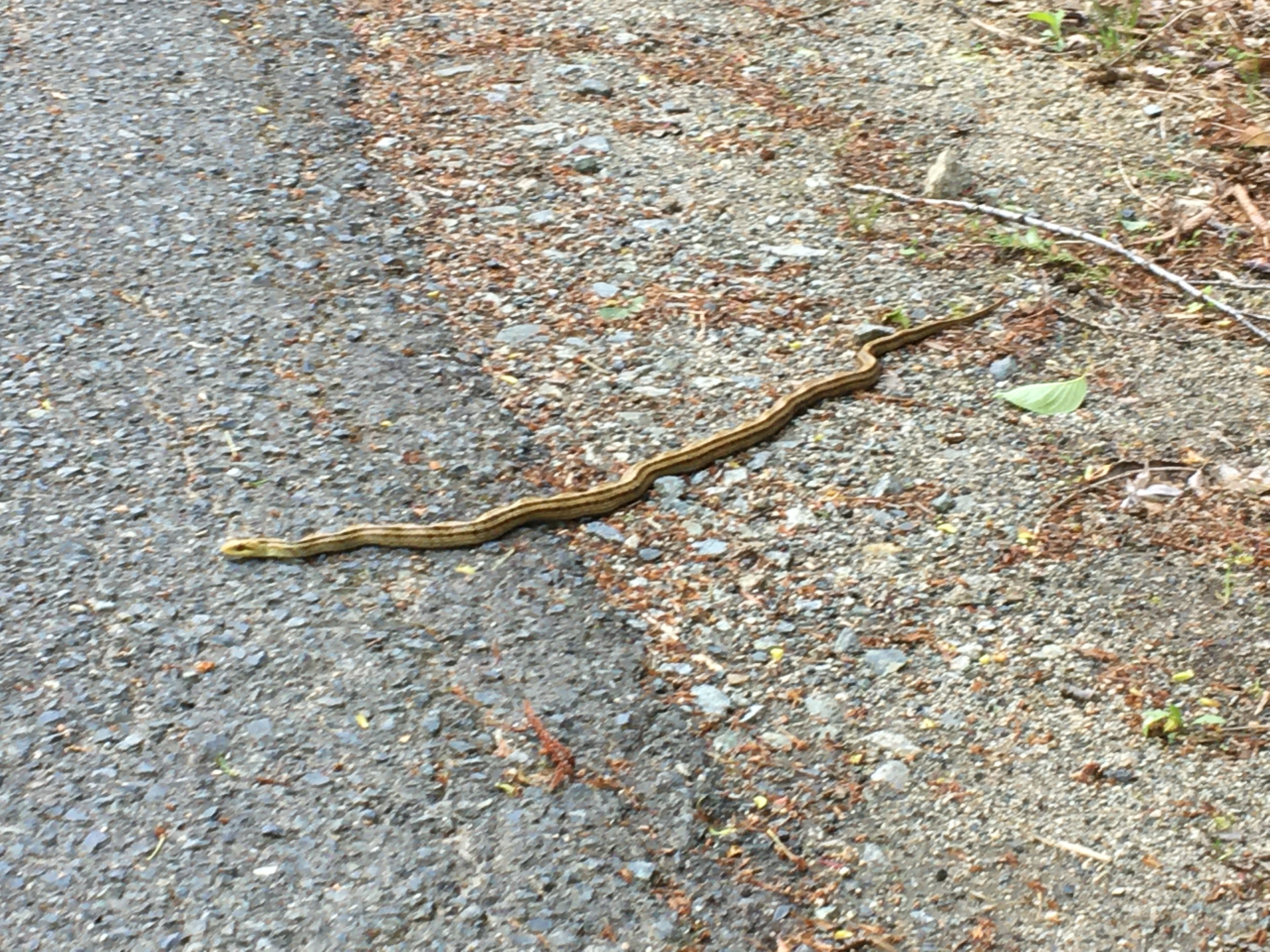
[We saw a snake in front of us, 我々の前にシマヘビが現れた。`우리는 줄무늬뱀을 보았다.]
After lunch, we returned the same way and headed to Hotel Okuma, where my son works.
Hotel Okuma is located right next to the Okuma Town Office and the area around the Town Office was as beautiful as a well-maintained park.
Especially at this time, the moss phlox was beautiful and the wisteria flowers were in bloom, but this one is still young and it seems that it will take several years to see it in full bloom.
[Moss phlox at the park next to Ohkuma Town Office,大熊町隣の公園の芝桜、오쿠마 마치 옆의 공원의 잔디 벚꽃]
We stayed at Hotel Okuma on that day.
The walking distance on that day was 14.7km,
the number of steps was 23,064,
and the number of floors we climbed was only 4th floors.
----------------------------------------------------------------------------------------
鎌倉レポート第7号 「シドニーから鎌倉へ」「湘南平~高麗山」4月30日(土), 「双葉郡大熊町坂下ダム」5月4日(水)
「シドニーから鎌倉へ」
直前の検査で陽性判明。出発が2週間遅れる。
我々の初孫である直美の結婚式も無事終わったことから3年ぶりに帰国することに決め、シドニー発4月7日の航空券を購入した。
しかし、搭乗72時間前の4月5日のPCR検査の結果、陽性判定が出た。検査2日前の日曜日、私は喉の痛みを覚え、頭痛がした。だが、月曜日にはどちらも和らぎ、検査当日は症状はなかった。妻は検査当日まで無症状だった。
[With a house-mate of the share-house,シェアハウスの友人と妻、쉐어하우스 친구와 아내]
4月6日陽性判定が出た日から妻は軽い風邪の症状、すなわち喉の痛みが続き、GPに相談したところ「ファナドール」を処方された。熱はない。
シドニーではPCR検査ができる場所はドライブスルーが多く、無料である。ただし、旅行用の陰性証明を求める場合は有料である。我々はGPが紹介したパソロジストを利用し、一人150ドルを支払った。
[At Fandale Park (neighborhood), 近所のファンデール公園、동네 판데일 공원]
また、シドニーではPCR検査よりさらに簡便な市販のRATキットによる検査が可能である。
RAT検査は簡単にできるので翌週、自分でチェックすると1週間後の火曜日、私は陰性だが、妻は陽性になった。
出発48時間以内である4月11日水曜日の朝、RAT試験をすると二人とも陰性になった。そしてPCR試験を受けたが、その結果がなかなか出なかった。
出発24時間前の4月12日木曜日の午後9時になっても結果が出ず、その3時間後に「陽性」判定がSNSで届いた。航空券は搭乗24時間以上前なら変更がきくがこの時点で無駄にしてしまった。
この一週間後、「陰性証明」をもらうためのエージェントも79ドルというところを口コミで知り、そちらを利用した。まず74時間前に無料のPCR検査を受けて「陰性」であることを確認し、次に48時間前に有料の検査を受け、今度はめでたく「陰性証明」を受け取った。
[A set of completed documents, 受領した必要書類、수령한 필요서류]
結局当初の予定より2週間遅れで、4月21日にシドニーを発ち、22日に羽田に到着した。
羽田ではさらに到着後PCR試験が義務付けられており、その結果が陰性であるばあいのみ隔離なしに入国できる。
シドニーのPCR検査は口腔内および鼻腔内をこすって検体ととるが、羽田では唾液を検体とする。私は持病の糖尿病のため、唾液が出ず、主に子供たちが対象の鼻腔内から検体を採取する列にならび、大いに苦労した。
到着3時間後にようやく解放されたが、次は自宅への移動手段の問題に直面した。
羽田空港から大船行きの直通バスは便数が少なく、到着した日は夕方まで便がない。止むを得ず自宅までタクシーを利用した。料金は14500円だった。
「湘南平~高麗山」4月30日(土)
帰国後最初のハイキングはと湘南平で同行者は松本氏。9時に自宅を出て、東海道下りホームからJRに乗車。大磯に9時半ごろ着。駅前を線路に沿って下り、大磯小学校前の地下通路を通って反対側へ出た。
すぐに住宅街の舗装道路を上り、高田(保)公園に出る。このあたりから相模湾の展望が開け、伊豆大島が良く見える。
[A view of the ocean from the hill, 丘の上から見た湘南の海、언덕 위에서 본 쇼난의 바다]
高田保の碑の横から本格的な登山路に入り、尾根伝いに羽白山経由で東小磯配水池のタンクを左に見て、道なりに進むと3方向案内標識に出る。
[Under wisteria flowers at Takata Park,高田公園のフジの花の下で、타카타 공원에서]
ここを直進すると突き当りを左に登れば湘南平である。湘南平は麓から続く車道があり、車で来ることができる。以前、喜久子の運転で来たことがある。
途中にテレビ塔があるが、こちらは登れない。湘南平には立派な展望台があり、レストハウスや駐車場もある。ここで展望台に上った。
[TV Tower at Shonan Daira, 湘南平のテレビ塔、쇼난 다이라의 TV 타워]
相模湾から伊豆大島はもちろん、左側には江の島や三浦半島、そして三浦アルプスを越えて房総半島も、鋸山らしい山容も見える。
[A view from the observatory, 展望台から見た風景、전망대에서 본 풍경]
相模湾の右側に目を転じれば、箱根の二子山や伊豆半島が良く見え、箱根の右側には丹沢山塊と大山の堂々たる姿が明確に見えた。
しかし、それらの後ろにそびえる富士山はあいにく雲がかかり、頂上近くの中腹の一部しか見えない。
[At the observation deck, 展望台にて、전망대에서]
テレビ塔の近くにも山側にやや低い展望台があり、こちらを見てからテーブル付きベンチを探し、早いランチをとった。
下りはテレビ塔方向へ戻り、浅間山方向の尾根伝いに八俵山(はっぴょうやま)を経て高麗山(こまやま)に至る。
さらに女坂を経由して高来神社に下った。雰囲気的には高尾山に似ているかもしれない。
市街地に出てからは、風情のある化粧坂松並木を通り、線路に並行して歩いて大磯駅に戻った。
一日の歩行距離は14.2㎞、歩数は21,017歩、階段は80階だった。
「双葉郡大熊町坂下ダム」5月4日(水)
ゴールデン・ウィークの3連休、5月3日~5日を利用して次男一家の住む福島県双葉郡富岡を訪れた。
次男は6年前の2016年2月に結婚し、夫婦で東日本大震災の復興事業に携わっている。
震災による津波で事故を起こした東電の原子力発電所がある双葉郡富岡町に移住し、生活してる。一方、3歳の長女と3カ月になる長男がいて、子育ての真っ最中でもある。
[In the field of canola flowers,菜の花畑の中で、유채꽃밭에서]
妻は子守りの手伝いというミッションがあるが、この件に関しては私は役立たずである。
したがって、長男の100日祝いの「お食い初め」に参加した以外は例によりハイキングを楽しんだ。
次男は現在、復興支援のボランティア活動の他、ホテルの従業員として働いている。息子の勤務先は富岡町の隣町である大熊町のホテルおおくまである。
[At Hotel Ohkuma, ホテル・オオクマにて、호텔 오오쿠마에서]
この日は息子の勤務先のホテルに同行し、ここを出発点にして地元の名所?「坂下ダム」へ向かった。同行者は前回同様松本氏である。
弁当やATMを使うためコンビニを探したが、ホテル近くのコンビニは地元のコンビニでATMはない。昼食用の弁当とスナックのみ購入してATMのあるコンビニは帰路に探した。
次男から受け取った地元の地図を見ながら、坂下ダムへ向かった。途中、今年3月16日のマグニチュード7.4の地震の爪痕が崩れた塀などに残る。
花は八重桜が残っていたほかはシャクナゲやつつじが満開で美しい。
[A rhodorendran tree on Ohkuma, 大熊町のシャクナゲ、석남(石南)꽃]
坂下ダムは熊川にかかるダムで畔に立つ説明板を読むと用水・発電の他、東京電力福島第一原子力発電所へ続く「東電導水管」が設置されている。
東電の原子力発電所は2011年3月11日に起こった東日本大震災及びその後の大津波、原子炉溶解により11年を経た現在も廃炉作業が続いている。
したがって現在は用水と電力発電のために利用されているのだろう。湖畔にはソメイヨシノが植樹されていて、満開時にはさぞ多くの人々が訪れることであろう。
この日は我々以外には訪問客はなく、静かな湖畔をゆっくりと歩いた。湖畔の一部と周囲の山は立入禁止サインがあり、線量が高いためとある。
[The sign of no entry, 登山路立入禁止の標識、등산로 출입 금지 표지판]
湖畔を1時間ほど進むと東屋があり、ここで昼食をとった。
途中、「マムシに注意」のサインがあったが、我々が遭遇した蛇はどうもシマヘビらしい。
[The sign says "Be aware of adder", 『マムシに注意』標識、『살무사에 주의』의 표지]
また、湖畔の道から山に入ったところに「美女泣かせのせせらぎ」という標識があったが、こちらも線量が高く、立入禁止である。
[We saw a snake in front of us, 我々の前にシマヘビが現れた。`우리는 줄무늬뱀을 보았다.]
昼食後は同じ道を引き返し、息子が務めるホテルおおくまへ向かった。
ホテルおおくまは大熊町役場のすぐそばに所在し、町役場の周りは整備された公園のように美しかった。
[Moss phlox at the park next to Ohkuma Town Office,大熊町隣の公園の芝桜、오쿠마 마치 옆의 공원의 잔디 벚꽃]
とくにこの時期は芝桜が美しく、また、フジの花も咲いていたが、こちらはまだ若く、見ごろになるのはまだ数年かかりそうだ。この日は、ホテル大熊で宿泊した。
この日の歩行距離は14.7、歩数は23,064歩、階数は4階であった。
I like hiking very much. I used to go hiking with a Korean hiking club named “AhToSan.” This blog introduces mostly my hiking activities in Korea and Japan, and Sydney in Australia. As of January 2020, I live in Sydney suburb. I go Blue Mountains and bush walk in Sydney area. 私は2003年から2014年まで韓国の大田(テジョン)に住んだ日本人である。11年間、週末は主に「アトサン山岳会」に参加した。14年4月に帰国したが、2020年以降はおもにシドニーで暮らし、時折、日本へ帰国する程度である。したがって最近の記事はSR(Sydney Report)としてブルーマウンテンのトレッキングを中心に書いている。
About pictures/当ブログ内の写真について/당 블로그내의 사진에 대해서
Most of the pictures in this blog are taken by my camera, yet some of them were downloaded from the website of the hiking club. If you click any pictures, they become the original size.
当ブログ内の写真の大部分は筆者のカメラで撮影したものですが、一部、山岳会の共有写真からダウンロードしたものを含みます。すべて、各写真をクリックすれば、元のサイズに拡大します。
당 블로그내 사진의 대부분은 필자의 카메라로 촬영한 것입니다만 일부 산악회 공유 사진으로부터 다운한 것도 포함합니다. 모두 각 사진을 클릭하면, 원래 사이즈에 확대합니다.
当ブログ内の写真の大部分は筆者のカメラで撮影したものですが、一部、山岳会の共有写真からダウンロードしたものを含みます。すべて、各写真をクリックすれば、元のサイズに拡大します。
당 블로그내 사진의 대부분은 필자의 카메라로 촬영한 것입니다만 일부 산악회 공유 사진으로부터 다운한 것도 포함합니다. 모두 각 사진을 클릭하면, 원래 사이즈에 확대합니다.
2022年6月24日金曜日
2022年4月13日水曜日
SR 42 "Kikurage (Jew’s-ear) and Ginger Lily" "Granddaughter's Wedding" "The Last Great North Walk" SR 42号 「キクラゲとジンジャーリリー」「孫娘の結婚式」「最後のザ・グレート・ノース・ウォーク」"목이버섯과 진저 릴리" "손녀의 결혼식" "마지막 더 그레이트 노스 워크""키쿠라게와 진저 릴리" "손녀의 결혼식" "마지막 더 그레이트 노스 워크"
SR 42 "Kikurage (Jew’s-ear) and Ginger Lily" "Granddaughter's Wedding" "The Last Great North Walk"
"Kikurage (Jew’s-ear) and Ginger Lily"
Every Thursday afternoon, I walk with Marshal from Taiwan and Mr. Lu from Guang Zhou, in Guangdong Province.
Last February when we were walking in High Street in Chatswood, we found “Kikurage” mushrooms, or Jew’s ears on a roadside tree.
I wondered if they were out this year, and when I went to High Street, this year I saw more than last year.
[Kikurage or Jew's ears, キクラゲ、목이(木耳)버섯]
I borrowed a step stool from Marshall, whose house is relatively close to my place, and harvested the mushrooms again. I enjoyed the mushrooms for several weeks as a part of ingredients for miso soup or stir-fried vegetables.
[Kikurage or Jew's ears, キクラゲ、목이(木耳)버섯]
There are many rainy days in NSW this year. If it rains a little, I walk around the nearby Ferndale Park. Entering from the entrance near Banya Pine which I introduced in the previous issue.
Nowadays I see bright yellow flowers wet in the rain. They are ginger lilies, family of ginger. The leaves and flowers are very similar to ginger, but they are large in size and the flowers are really beautiful.
[Ginger lily (Hedychium), ジンジャー・リリー、진저 릴리]
The roots are similar to ginger, but they are not edible.
[A creek in the park, 公園内の小川、공원내의 개울]
I also see big eels in the creek. These eels can be found all over the creek and come in a variety of sizes, so it seems that there are quite a few of them.
[A big eel in the creek, 散策路の小川の中に住むウナギ、산책로의 시내에 사는 장어]
"Our granddaughter's wedding"
Our eldest son went to Australia as an exchange student when he was a graduate school in Japan. He got a Ph. D at UTS in Sydney and married a girl from Shanghai, China.
Blessed with one son and three daughters, their eldest daughter, Naomi, was born in 2000. Naomi will be 22 years old this year.
I also got married at the age of 22. My wife and I both graduated from high school and started working immediately, so we had already had four years of working experience.
Both Naomi and Gab, the groom are in their fourth year of college, but they've been steady for past seven years.
What surprised me most is the cost sharing way. They say that the cost of wedding reception is paid by the father of the bride, and the cost of honey moon is paid by the father of the bridegroom. Wow, they say this is the Aussuie style.
The wedding ceremony was held at a church in Naremburn Cammeray Anglican Church.
It reminded me of the wedding of Hajime and Louise in 1999. Attendants of the ceremony were about 200 people. There were 4 groomsmen and 4 bridesmaids.
[The bride's parents, grandma, brother,花嫁の両親と祖母と弟、신부의 부모와 할머니와 동생]
The first song at the ceremony was “All Glory Be To Christ” in the tune of “Auld Lang Syne.” It surprised me a bit because “Auld Lang Syne” melody is commonly used for “farewell” occasion in Japan.
According to Wikipedia, “Auld Lang Syne” is an old Scottish folk song, and it is often sung at the occasions such as New Year Eve, wedding receptions, birthdays, and it is also sung as a hymn. Here for this occasion, it was “All Glory Be To Christ.”
The next song after the wedding pledge was “10,000 Reasons” which we sing often at our church (Chatswood Presbyterian Church). It is a relatively new worship son leased in 2011.
And the Bible quate for the preach was Hosea 2:16 – 23, and John 2:11.
The father of the bridegroom is Chilian, and mother is Anglo, and the bride’s father is Japanese and her mother is Chinese. So, if they have kids then they have 4 ethnicities.
[The bridegroom and assistants are waiting for the bride,花嫁を迎える新郎とアシスタントたち、신부를 맞이하는 신랑과 들러리들]
The bridegroom’s name is Gabriel which is a name of Engel from the Bible. His parents are faithful Christians. Naomi, our granddaughter is also named from the of Ruth, the Bible. Her parents are also faithful Christians.
[Bride's father led his daughter,新婦の父から新郎へ、신부의 아버지에서 신랑으로]
Gab hopes to work for the church, possibly as a missionary in the future. Naomi could be a wife of missionary. But intriguing fact is that she is majoring in Aerospace Engineering. What a combination of Christianity and Aerospace Engineering!
[The wedding ceremony at a church, 教会で孫娘の結婚式、교회에서 손녀의 결혼식]
The wedding reception was held at a restaurant in Daring Harbour from which the guests can enjoy magnificent view of the harbour. The number of the guests was 150.
[The restaurant looking down Darling Harbour, ダーリングハーバーを見下ろすレストラン、달링 하버가 내려다 보이는 레스토랑]
During the lockdown time, even having a wedding was prohibited. After that worst period, sill for a while the number of people for a wedding had been limited, but now there is no such restriction so it was possible to have 150 guests this time. We could enjoy the magnificent view of Darling Harbour, while enjoying a chat with other guests, having free drinks and hors deVere.
[We enjoyed the view with drinks before the reception, 披露宴前の待機時間中、피로연 전 대기 시간 중]
At just 6 pm, all guests were urged into the restaurant. All seats were assigned according to the categories.
The bride and bridegroom entered the hall after 4 couples of ushers (a couple with grooms man and brides maid).
[A couple of ushers enter the party, アッシャーの一組が入場、애셔의 한 쌍이 입장]
There was no such as special guest’s speech like in Japan, but the best man did a wonderful speech. And both bride and bridegroom’s fathers did their moving speeches. My son, Hajime, did an excellent speech, I thought.
[The bride's father made a speech, 新婦の父がスピーチした。신부의 아버지가 축복 연설했다.]
It seems not much difference between Japanese style and Aussie style as far as cutting the wedding cake and lighting candles ceremony.
[Cutting the wedding cake, ウェディング・ケーキ入刀、웨딩 케이크 컷팅]
After having 3 hours of enjoying our dinner and drinks, then they began to play discotic music. Everyone began to dance in disco style.
[Discotic dance at the party, 披露宴でディスコダンス、피로연에서 디스코 댄스]
Nobody wore mask, and we really enjoyed the music and dance. It seems to me, now there is no pandemic world anymore. All guests and human tunnel, and the bride and bridegroom walked through the tunnel. Then finaly, the reception was over.
"The Last ‘Great North Walk’"
Compared to Japan, NSW has very few natural disasters and a mild climate. We recognize that NSW's major natural disaster is bushfire, but it seems that a "flood" will be added to this.
There have been many rainy days since January this year, and on March 8th it rained really hard.
The street in front of the shared house was like a river in Chatswood.
Heavy rain also fell in the Blue Mountains area on that day, and landslides occurred at three locations on the Blue Mountains Line.
Now the Blue Mountains Line is not available just like 3 years ago when the bushfires were rampant.
So, we changed the direction from the West to the North. We walk on the Great North Walk in March.
The Great North Walk (or GNW) is a 250 km path from central Sydney to downtown Newcastle in Australia. It is a truly wonderful trail following many tracks through a bewildering array of natural and urban environments.
http://www.thegreatnorthwalk.com/track/
There are 30 sections, each consists of about “one day trekking course.” Isaac and I walked from #1 to about half of #16 together. We also walked from #28 to #30, the last 3 sections already.
This time, I walked from #1 and #2 on March 12 with my best trekking pals, Isaac and Mr. Kim, and also #28 with them on March 19 as my final trekking in NSW this time.
1) First and 2nd sections of the GNW on 12 March.
The first section starts from Obelisk at Macquarie Place near Circular Quay. Actually I walked on Section 1 several times. So we started our journey by taking the ferry from Circular Quay to Woolwich Wharf.
[The bottom of the obelisk, オベリスクの底部、오벨리스크의 하단]
I like this ferry ride because I can enjoy wonderful views of Sydney Harbour including Opera House, Harbour Bridge, and picturesque Sydney shores. The ferry left at 9:45 am and arrived at Woolwich Wharf at 10:15 am.
[At Woolwich Wharf, ウールウィッチ埠頭にて、울위치 부두에서]
The trekking course from Woolwich to Boronia Park, we could enjoy historical buildings and streets on Hunters Hill area. Then we come to the Lane Cove River.
[My trekking pals for this trekking, 私の二人のオーストラリアの山友、호주의 한국 트레킹 친구들]
We arrived at Boronia Park at 11:45. It was a bit too early to have our lunch. So we just had some snack and moved to the 2nd section.
The 2nd section: from Boronia Park to North Ryde
http://www.wildwalks.com/bushwalking-and-hiking-in-nsw/lane-cove-national-park/boronia-park-to-north-ryde.html
This course, we walked along the Lane Cove River. The trails run among mangrove trees. We walked along the rocky shores up and down several times. We arrived at Magdala Park at 1:30 pm. We had a bit late lunch there and ended the day trip there.
The formal destination is North Ryde station, but Mr. Kim’s home is on the opposite of the direction, and as for Isaac, he had to access Chatswood station, so we took a bus from nearby bus stop.
[At Magdala Park with Mr. Kim、キムさんとマグダラ公園にて、김씨와 막달라공원에서
Daily walking distance:20.4 km.
Daily steps:28,656/ Stairs: 30 floors.
2) The 28 section of GNW on 19 March from Teralba to Charlestown.
At last, my last trekking day with my Korean friends in Australia came. My trekking pals are again Isaac and Mr. Kim. Mr. Kim is the first Korean hiker I ever met in Sydney in 2016. Thanks to Mr. Kim, I became to know many Korean hikers in Sydney and I guided 10 Korean people to Mt. Fuji and Mt. Yarigatake in 2018.
I became to know Isaac after guiding those Koreas in Japan in August 2018. But he is the one who accompanied to walk on GNW. The is the most enthusiastic hiker to walk with me on Saturday.
So, I am glad that they joined me for my last trekking.
The weather was not so good. It rained a bit hard in the morning. But they came to Epping station in the morning. We took the train which headed for New Castle Interchange.
We got off at Teralba station and walked along Lake Macquarie. It is a wide scenic area with nice exercise facilities. When we came to the middle of the course, it began to rain a bit and Isaac suggested to have a break at a café near King’s Street.
[An object along Lake Macquarie, マッコーリー湖畔のオブジェ、맥쿼리 호수 옆의 오브제]
It was about 11:45 and I offered some sweet potatoes, and Mr. Kim offered some Korean cakes. We had a nice break and it stopped raining when we started walking.
[A cafe near Lake Macquarie, マッコリ―湖畔のカフェ、맥쿼리호수 근처의 카페]
We had lunch when we came to a small park near the end of Queen’s Street.
Then we came into the bushwalking trail. This must be my 3rd time, yet I lost the sign of GNW when we came to the Power Line track.
Fortunately, Isaac remembered the right track well, so we lost only a short time
When we came to the swampy area near the golf course, lots of mosquitoes attacked us. (It happened before when we came last time.) Isaac kindly shared his chemical stuff to prevent mosquitoes and it worked well.
We arrived at the destination, Charlestown Rotary Park at 3 pm. We took a bus from a bus-stop at Charlestown Square to Cardiff, and we took 3:59 pm train to go back to Epping, then I said goodbye to them and I arrived at Chatswood at 6:22.
[The Charlestown Rotary Park,チャールズタウン・ロータリー・パーク、찰스 타운 로타리 파크]
Total walking distance of the day was 18.1 km.
Walking steps was 27,318 and the number of floors:36.
---------------------------------------------------------------------------------------
SR 42号 「キクラゲとジンジャーリリー」「孫娘の結婚式」「最後のザ・グレート・ノース・ウォーク」
「キクラゲとジンジャーリリー」
木曜午後のトレッキングは台湾人のマーシャルと中国の広州から来た盧氏とチャッツウッド周辺を歩く。
昨年、2月、チャッツウッドのハイ・ストリートを歩いているとき、大きな街路樹にキクラゲがたくさん自生しているのを見つけた。
[Kikurage or Jew's ears, キクラゲ、목이(木耳)버섯]
今年も出ているかと思い、ハイ・ストリートへ行くと、今年は昨年にも増してたくさん自生していた。比較的家が近い、マーシャルから踏み台を借りて収穫した。これは乾燥せずにそのまま味噌汁や野菜炒めの具にして数週間、楽しんだ。
[Kikurage or Jew's ears, キクラゲ、목이(木耳)버섯]
今年のNSW州は雨の日が多い。私は多少の雨なら、近所のファンデール・パークを歩く。前号で紹介したバンヤ・パインのそばの入り口から入って、クリーク沿いにあるくと雨に濡れて鮮やかな黄色い花が目につく。
[Ginger lily (Hedychium), ジンジャー・リリー、진저 릴리]
これはジンジャーリリーのいってショウガの仲間である。葉や花はショウガやミョウガによく似ているが、サイズが大きく、花は特に美しい。根っこもショウガそっくりであるが食用にはならない。
[A creek in the park, 公園内の小川、공원내의 개울]
また、小さなクリークだが大きなウナギもよく見かける。このウナギはクリークのあちこちで見かけ、サイズも色々なのでかなりの数が生息しているようだ。
[A big eel in the creek, 散策路の小川の中に住むウナギ、산책로의 시내에 사는 장어]
「孫娘の結婚式」
我々の長男は日本の大学院時代に豪州に渡り、こちらで博士号を習得したのち上海出身のオージーと結婚して今に至っている。1男3女に恵まれ、長女、ナオミは2000年生まれなので今年22歳である。我々も22歳の時に結婚した。
妻も私も高卒ですぐに働き始めたのですでに社会人経験4年であった。ナオミと新郎ギャブはどちらも大学4年生であるが、彼らはステディになってすでに7年経っている。
驚いたことに結婚式の費用は新婦側の父親が、新婚旅行の費用は新郎側の父親が負担するのがオージー式だという。
[Bride's father led his daughter,新婦の父から新郎へ、신부의 아버지에서 신랑으로]
結婚式はナランバンの教会で、2時から4時ごろまで。自分たちの結婚式より、教会で挙式した息子の結婚式のことを思い出した。
[The wedding ceremony at a church, 教会で孫娘の結婚式、교회에서 손녀의 결혼식]
今回の出席者は約200名でグルームズマンが4人、ブライズメイドが4人、それぞれ新郎新婦をアシストした。
全員がそろって最初に歌った歌のメロディーがなんと「蛍の光」であったことに驚いた。
この曲は日本ではかつて卒業式の定番であり、別れの歌でもある。
ウィキペディアによると原曲の「オールド・ラング・サイン」は古くからスコットランドに伝わっていた歌で、現在に至るまで、特に年始、披露宴、誕生日などで歌われるとされている。また、讃美歌としても歌われ、ここでは「すべての栄光はキリストに」というものだった。
結婚の誓約に続いて歌った歌は、我々の通う教会でもよく歌われる讃美歌で「一万の理由(10,000 Reasons)」という2011年にリリースされた比較的新しいワーシップソングだった。
そして本題の引用聖句は旧約聖書からホセア書の2章16-23節およびヨハネによる福音書の2章1-11節だった。新郎の両親は父親がチリ、母親が英国系のクリスチャンで息子を大天使「ガブリエル」と同じ名前を与えた。新婦の両親もクリスチャンであり、彼らの娘を旧約聖書ルツ記から「ナオミ」と命名した。
新郎の将来の希望は宣教師として福音を伝えることであると聞いている。しかし、新婦の大学(NSW州立大学)の専攻は航空宇宙工学(Aerospace Engineering)また、彼らに子供が生まれた場合、その民族性はチリ、英国、日本、中国と4つの民族になる。
披露宴はダーリングハーバーを見下ろす素晴らしい景観を楽しめるレストランで、招待客は150人だった。
[The restaurant looking down Darling Harbour, ダーリングハーバーを見下ろすレストラン、달링 하버가 내려다 보이는 레스토랑]
昨年のロックダウン中は、結婚式そのものが禁止された期間もあったが、現在は人数制限も緩和が進み、150人も可能となった。
披露宴は会場のテラスに5時半から入場ができ、客たちは好みのドリンクを片手に素晴らしい景観を楽しめた。
6時になると室内の会場に場所を移し、あらかじめ指定された席に着いた。
[The newly married couple and the bride's parents,新婚夫妻と花嫁の両親、신혼 부부와 신부 부모]
新郎新婦の入場は、4組のアッシャーであるグルームズマンとブライズメイドがそれぞれ手をつないで先導した。
[A couple of ushers enter the party, アッシャーの一組が入場、애셔의 한 쌍이 입장]
日本のように来賓の挨拶はなく、新郎側の友人代表がベストマンとして堂々たるスピーチをした。また、新郎新婦の父親がそれぞれ感動的なスピーチをした。
[The bridegroom's father made a speech. 新郎の父親がスピーチした。신랑의 아버지가 연설했다.]
ウェディング・ケーキ入刀もテーブルのキャンドル点火も日本で見るパーティ同様であるが、パーティが始まって3時間も経過したころ、にぎやかなディスコダンスが始まった。
[Cutting the wedding cake, ウェディング・ケーキ入刀、웨딩 케이크 컷팅]
もう完全にパンデミック前の世界に戻ったようで、みな歌って踊って、大盛会となり、出席者のアーチの下を新郎新婦が潜り抜けてお開きとなった。
[Discotic dance at the party, 披露宴でディスコダンス、피로연에서 디스코 댄스]
「最後のザ・グレート・ノース・ウォーク」
NSW州は日本に比べ自然災害が非常に少なく、気候も温暖である。NSWの大きな自然災害はブッシュファイアーであると認識しているが、これに「洪水」が加わるようだ。
今年は1月から雨の日が多く、3月8日には我々の住むチャッツウッドの目の前の通りが川のようになる豪雨が降った。
この日は、ブルーマウンテン地域にも大雨が降り、ブルーマウンテンズ・ラインの3か所で土砂崩れが発生した。そして3年前の大規模ブッシュファイア以来の前線不通となった。
だが、私にとってはブルーマウンテンがだめなら、シドニーから北上してニューキャッスルに至る「ザ・グレート・ノース・ウォーク」がある。
これはシドニーコーブを始発として、ニューキャッスルに至る260kmのブッシュ・ウォークの大トラック(散策路)である。
ブルーマウンテンズ・ラインが不通になった翌週の土曜日は、ザ・グレート・ノース・ウォークの第1および第1セクションを歩くことにした。
1) ザ・グレート・ノース・ウォーク#1
第1セクションはシドニーを起点として全国への道路建設が始まった、マッコーリープレイスのオベリスクからレイン・コーブ・リバーの河口のボローニャパークまでの6㎞である。
http://www.wildwalks.com/bushwalking-and-hiking-in-nsw/sydney-harbour-south-side/sydney-to-boronia-park.html
同行者は6年前の初めての出会いよりこれまで一番長く同行したチャッツウッドのキムさんと、私と一緒に一番多くトレッキングを共にしたパラマッタのアイザックである。
我々はシドニー港の鉄道駅であるサーキュラー・キー駅出口で待ち合わせして、第5埠頭からカッカトゥー・アイランド行きのフェリーに乗船した。
[Overlooking Sydney Bay from Circular Quay Platform, サーキュラーキー駅のプラットホームからシドニー湾を望む、서큘러 키 역 플랫폼에서 시드니 베이를 바라본다]
フェリーは1時間に1本で、この日は9:45出発のフェリーに乗船。オペラハウスを右にみて、シドニー・ハーバー・ブリッジの下を通過して、3,4番目の波止場であるウールウィッチに10:15に到着した。
ウールウィッチからボローニャパークまでのコースはシドニーの歴史的町並みを残すハンターズ・ヒル地域を通り、レインコーブ・リバーの岸辺を行く風光明媚なコースである。
我々はボローニャパークには11:45に到着した。ここではランチには早いというので小休止のみにして第2セクションへと歩みを進めた。
[My trekking pals for this trekking, 私の二人のオーストラリアの山友、호주의 한국 트레킹 친구들]
ボローニャパークからはレインコーブ・リバーに沿って上流へ向かうコースで、マングローブの林や沿岸の岩場を緩やかに登ったり下りたりを繰り返し、第2セクションの終点のマグダラパークに1時半に到着した。
[A wild flower along the 2nd section of the GNW, ザ・グレート・ノース・ウォークの路傍の花、그레이트 노스 워크의 길가에 꽃]
本来のコースはさらにノースライド駅まで続くのだが、すでに14㎞ちかく歩いていて、キムさんの自宅はレインコーブ・ナショナルパーク方面、アイザックはチャッツウッドに出てさらにパラマッタへ戻らねばならないので、我々はマグダラ・パークで遅いランチをとった後、別れた。
2) ザ・グレート・ノース・ウォーク#28 (テラルバ~チャールズタウン13.3 km)
http://www.wildwalks.com/bushwalking-and-hiking-in-nsw/hunter-region/teralba-to-charlestown-park-track-head.html
ザ・グレート・ノース・ウォークの260kmは日帰りで歩ける30セクションに区切られ、シドニーを出発してニューキャッスルに至る。
このうち、公共交通機関のアクセスがあるのは#1~#16と、最後の#28~#30区間である。
今回の滞豪最後のトレッキングは3月19日に決行。この日も、キムさんとアイザックが同行した。
この日の朝、かなり強い雨が降ったが、出かけるころ止んだ。エッピングでキムさん、アイザックが合流。
GNWの28番目、テラルバ駅~チャールズタウンの13.5㎞を歩いた。
途中降られたのはマッコーリー湖からキングズストリートへ左折する部分のみ。この地点までで約半分。湖畔にはなんとなく日本の小僧さんの人形のようなオブジェを見た。
[An object along Lake Macquarie, マッコーリー湖畔のオブジェ、맥쿼리 호수 옆의 오브제]
アイザックがコーヒーを飲んでいこうと言い出し、店に入って注文。14ドルを払って、店先のテーブルで待っている間に止んだ。
[At a cafe near Lake Macquarie, マッコリ―湖畔のカフェにて、맥쿼리호수 근처의 카페에서]
私が持参したスィートポテトは白かったが適度に甘く、ちょうどよい休憩になった。
キングズストリートからクイーンズストリートに入り、直進後、右折して突き当りの公園でランチにした。
ここからブッシュウォークに入ったが、電力線トラックで標識を見失ったのは前回と同様。
しかし、アイザックが前回の経験を覚えていて、パワーライントラックを少し上ったところで標識を発見。
あとは見失うことなく、チャールズダウン・ロータリー公園まで到達したが、途中、ゴルフ場付近が湿地帯で、おそろしくやぶ蚊が多くとりついた。
[At The Charlestown Rotary Park,チャールズタウン・ロータリー・パークにて、찰스 타운 로타리 파크에서]
やぶ蚊は最後までとりついたが、アイザックの塗り薬と消毒布でさっぱりした。
公園からチャールズタウン・スクェアのバス停まで下り、バスを待った。最初に来たバスがCardiffを通るバスだったのでそれに乗ったがこれは正解だった。
10分ほどでCardiffに着いたが、電車が出たばかりで40分、ホームで待った。15;59発の電車で、エッピングで二人に分かれ、チャッツについたのは6:22だった。
この日の歩行距離は18.1km、歩数は27,318歩、階段は36階だった。
"Kikurage (Jew’s-ear) and Ginger Lily"
Every Thursday afternoon, I walk with Marshal from Taiwan and Mr. Lu from Guang Zhou, in Guangdong Province.
Last February when we were walking in High Street in Chatswood, we found “Kikurage” mushrooms, or Jew’s ears on a roadside tree.
I wondered if they were out this year, and when I went to High Street, this year I saw more than last year.
[Kikurage or Jew's ears, キクラゲ、목이(木耳)버섯]
I borrowed a step stool from Marshall, whose house is relatively close to my place, and harvested the mushrooms again. I enjoyed the mushrooms for several weeks as a part of ingredients for miso soup or stir-fried vegetables.
[Kikurage or Jew's ears, キクラゲ、목이(木耳)버섯]
There are many rainy days in NSW this year. If it rains a little, I walk around the nearby Ferndale Park. Entering from the entrance near Banya Pine which I introduced in the previous issue.
Nowadays I see bright yellow flowers wet in the rain. They are ginger lilies, family of ginger. The leaves and flowers are very similar to ginger, but they are large in size and the flowers are really beautiful.
[Ginger lily (Hedychium), ジンジャー・リリー、진저 릴리]
The roots are similar to ginger, but they are not edible.
[A creek in the park, 公園内の小川、공원내의 개울]
I also see big eels in the creek. These eels can be found all over the creek and come in a variety of sizes, so it seems that there are quite a few of them.
[A big eel in the creek, 散策路の小川の中に住むウナギ、산책로의 시내에 사는 장어]
"Our granddaughter's wedding"
Our eldest son went to Australia as an exchange student when he was a graduate school in Japan. He got a Ph. D at UTS in Sydney and married a girl from Shanghai, China.
Blessed with one son and three daughters, their eldest daughter, Naomi, was born in 2000. Naomi will be 22 years old this year.
I also got married at the age of 22. My wife and I both graduated from high school and started working immediately, so we had already had four years of working experience.
Both Naomi and Gab, the groom are in their fourth year of college, but they've been steady for past seven years.
What surprised me most is the cost sharing way. They say that the cost of wedding reception is paid by the father of the bride, and the cost of honey moon is paid by the father of the bridegroom. Wow, they say this is the Aussuie style.
The wedding ceremony was held at a church in Naremburn Cammeray Anglican Church.
It reminded me of the wedding of Hajime and Louise in 1999. Attendants of the ceremony were about 200 people. There were 4 groomsmen and 4 bridesmaids.
[The bride's parents, grandma, brother,花嫁の両親と祖母と弟、신부의 부모와 할머니와 동생]
The first song at the ceremony was “All Glory Be To Christ” in the tune of “Auld Lang Syne.” It surprised me a bit because “Auld Lang Syne” melody is commonly used for “farewell” occasion in Japan.
According to Wikipedia, “Auld Lang Syne” is an old Scottish folk song, and it is often sung at the occasions such as New Year Eve, wedding receptions, birthdays, and it is also sung as a hymn. Here for this occasion, it was “All Glory Be To Christ.”
The next song after the wedding pledge was “10,000 Reasons” which we sing often at our church (Chatswood Presbyterian Church). It is a relatively new worship son leased in 2011.
And the Bible quate for the preach was Hosea 2:16 – 23, and John 2:11.
The father of the bridegroom is Chilian, and mother is Anglo, and the bride’s father is Japanese and her mother is Chinese. So, if they have kids then they have 4 ethnicities.
[The bridegroom and assistants are waiting for the bride,花嫁を迎える新郎とアシスタントたち、신부를 맞이하는 신랑과 들러리들]
The bridegroom’s name is Gabriel which is a name of Engel from the Bible. His parents are faithful Christians. Naomi, our granddaughter is also named from the of Ruth, the Bible. Her parents are also faithful Christians.
[Bride's father led his daughter,新婦の父から新郎へ、신부의 아버지에서 신랑으로]
Gab hopes to work for the church, possibly as a missionary in the future. Naomi could be a wife of missionary. But intriguing fact is that she is majoring in Aerospace Engineering. What a combination of Christianity and Aerospace Engineering!
[The wedding ceremony at a church, 教会で孫娘の結婚式、교회에서 손녀의 결혼식]
The wedding reception was held at a restaurant in Daring Harbour from which the guests can enjoy magnificent view of the harbour. The number of the guests was 150.
[The restaurant looking down Darling Harbour, ダーリングハーバーを見下ろすレストラン、달링 하버가 내려다 보이는 레스토랑]
During the lockdown time, even having a wedding was prohibited. After that worst period, sill for a while the number of people for a wedding had been limited, but now there is no such restriction so it was possible to have 150 guests this time. We could enjoy the magnificent view of Darling Harbour, while enjoying a chat with other guests, having free drinks and hors deVere.
[We enjoyed the view with drinks before the reception, 披露宴前の待機時間中、피로연 전 대기 시간 중]
At just 6 pm, all guests were urged into the restaurant. All seats were assigned according to the categories.
The bride and bridegroom entered the hall after 4 couples of ushers (a couple with grooms man and brides maid).
[A couple of ushers enter the party, アッシャーの一組が入場、애셔의 한 쌍이 입장]
There was no such as special guest’s speech like in Japan, but the best man did a wonderful speech. And both bride and bridegroom’s fathers did their moving speeches. My son, Hajime, did an excellent speech, I thought.
[The bride's father made a speech, 新婦の父がスピーチした。신부의 아버지가 축복 연설했다.]
It seems not much difference between Japanese style and Aussie style as far as cutting the wedding cake and lighting candles ceremony.
[Cutting the wedding cake, ウェディング・ケーキ入刀、웨딩 케이크 컷팅]
After having 3 hours of enjoying our dinner and drinks, then they began to play discotic music. Everyone began to dance in disco style.
[Discotic dance at the party, 披露宴でディスコダンス、피로연에서 디스코 댄스]
Nobody wore mask, and we really enjoyed the music and dance. It seems to me, now there is no pandemic world anymore. All guests and human tunnel, and the bride and bridegroom walked through the tunnel. Then finaly, the reception was over.
"The Last ‘Great North Walk’"
Compared to Japan, NSW has very few natural disasters and a mild climate. We recognize that NSW's major natural disaster is bushfire, but it seems that a "flood" will be added to this.
There have been many rainy days since January this year, and on March 8th it rained really hard.
The street in front of the shared house was like a river in Chatswood.
Heavy rain also fell in the Blue Mountains area on that day, and landslides occurred at three locations on the Blue Mountains Line.
Now the Blue Mountains Line is not available just like 3 years ago when the bushfires were rampant.
So, we changed the direction from the West to the North. We walk on the Great North Walk in March.
The Great North Walk (or GNW) is a 250 km path from central Sydney to downtown Newcastle in Australia. It is a truly wonderful trail following many tracks through a bewildering array of natural and urban environments.
http://www.thegreatnorthwalk.com/track/
There are 30 sections, each consists of about “one day trekking course.” Isaac and I walked from #1 to about half of #16 together. We also walked from #28 to #30, the last 3 sections already.
This time, I walked from #1 and #2 on March 12 with my best trekking pals, Isaac and Mr. Kim, and also #28 with them on March 19 as my final trekking in NSW this time.
1) First and 2nd sections of the GNW on 12 March.
The first section starts from Obelisk at Macquarie Place near Circular Quay. Actually I walked on Section 1 several times. So we started our journey by taking the ferry from Circular Quay to Woolwich Wharf.
[The bottom of the obelisk, オベリスクの底部、오벨리스크의 하단]
I like this ferry ride because I can enjoy wonderful views of Sydney Harbour including Opera House, Harbour Bridge, and picturesque Sydney shores. The ferry left at 9:45 am and arrived at Woolwich Wharf at 10:15 am.
[At Woolwich Wharf, ウールウィッチ埠頭にて、울위치 부두에서]
The trekking course from Woolwich to Boronia Park, we could enjoy historical buildings and streets on Hunters Hill area. Then we come to the Lane Cove River.
[My trekking pals for this trekking, 私の二人のオーストラリアの山友、호주의 한국 트레킹 친구들]
We arrived at Boronia Park at 11:45. It was a bit too early to have our lunch. So we just had some snack and moved to the 2nd section.
The 2nd section: from Boronia Park to North Ryde
http://www.wildwalks.com/bushwalking-and-hiking-in-nsw/lane-cove-national-park/boronia-park-to-north-ryde.html
This course, we walked along the Lane Cove River. The trails run among mangrove trees. We walked along the rocky shores up and down several times. We arrived at Magdala Park at 1:30 pm. We had a bit late lunch there and ended the day trip there.
The formal destination is North Ryde station, but Mr. Kim’s home is on the opposite of the direction, and as for Isaac, he had to access Chatswood station, so we took a bus from nearby bus stop.
[At Magdala Park with Mr. Kim、キムさんとマグダラ公園にて、김씨와 막달라공원에서
Daily walking distance:20.4 km.
Daily steps:28,656/ Stairs: 30 floors.
2) The 28 section of GNW on 19 March from Teralba to Charlestown.
At last, my last trekking day with my Korean friends in Australia came. My trekking pals are again Isaac and Mr. Kim. Mr. Kim is the first Korean hiker I ever met in Sydney in 2016. Thanks to Mr. Kim, I became to know many Korean hikers in Sydney and I guided 10 Korean people to Mt. Fuji and Mt. Yarigatake in 2018.
I became to know Isaac after guiding those Koreas in Japan in August 2018. But he is the one who accompanied to walk on GNW. The is the most enthusiastic hiker to walk with me on Saturday.
So, I am glad that they joined me for my last trekking.
The weather was not so good. It rained a bit hard in the morning. But they came to Epping station in the morning. We took the train which headed for New Castle Interchange.
We got off at Teralba station and walked along Lake Macquarie. It is a wide scenic area with nice exercise facilities. When we came to the middle of the course, it began to rain a bit and Isaac suggested to have a break at a café near King’s Street.
[An object along Lake Macquarie, マッコーリー湖畔のオブジェ、맥쿼리 호수 옆의 오브제]
It was about 11:45 and I offered some sweet potatoes, and Mr. Kim offered some Korean cakes. We had a nice break and it stopped raining when we started walking.
[A cafe near Lake Macquarie, マッコリ―湖畔のカフェ、맥쿼리호수 근처의 카페]
We had lunch when we came to a small park near the end of Queen’s Street.
Then we came into the bushwalking trail. This must be my 3rd time, yet I lost the sign of GNW when we came to the Power Line track.
Fortunately, Isaac remembered the right track well, so we lost only a short time
When we came to the swampy area near the golf course, lots of mosquitoes attacked us. (It happened before when we came last time.) Isaac kindly shared his chemical stuff to prevent mosquitoes and it worked well.
We arrived at the destination, Charlestown Rotary Park at 3 pm. We took a bus from a bus-stop at Charlestown Square to Cardiff, and we took 3:59 pm train to go back to Epping, then I said goodbye to them and I arrived at Chatswood at 6:22.
[The Charlestown Rotary Park,チャールズタウン・ロータリー・パーク、찰스 타운 로타리 파크]
Total walking distance of the day was 18.1 km.
Walking steps was 27,318 and the number of floors:36.
---------------------------------------------------------------------------------------
SR 42号 「キクラゲとジンジャーリリー」「孫娘の結婚式」「最後のザ・グレート・ノース・ウォーク」
「キクラゲとジンジャーリリー」
木曜午後のトレッキングは台湾人のマーシャルと中国の広州から来た盧氏とチャッツウッド周辺を歩く。
昨年、2月、チャッツウッドのハイ・ストリートを歩いているとき、大きな街路樹にキクラゲがたくさん自生しているのを見つけた。
[Kikurage or Jew's ears, キクラゲ、목이(木耳)버섯]
今年も出ているかと思い、ハイ・ストリートへ行くと、今年は昨年にも増してたくさん自生していた。比較的家が近い、マーシャルから踏み台を借りて収穫した。これは乾燥せずにそのまま味噌汁や野菜炒めの具にして数週間、楽しんだ。
[Kikurage or Jew's ears, キクラゲ、목이(木耳)버섯]
今年のNSW州は雨の日が多い。私は多少の雨なら、近所のファンデール・パークを歩く。前号で紹介したバンヤ・パインのそばの入り口から入って、クリーク沿いにあるくと雨に濡れて鮮やかな黄色い花が目につく。
[Ginger lily (Hedychium), ジンジャー・リリー、진저 릴리]
これはジンジャーリリーのいってショウガの仲間である。葉や花はショウガやミョウガによく似ているが、サイズが大きく、花は特に美しい。根っこもショウガそっくりであるが食用にはならない。
[A creek in the park, 公園内の小川、공원내의 개울]
また、小さなクリークだが大きなウナギもよく見かける。このウナギはクリークのあちこちで見かけ、サイズも色々なのでかなりの数が生息しているようだ。
[A big eel in the creek, 散策路の小川の中に住むウナギ、산책로의 시내에 사는 장어]
「孫娘の結婚式」
我々の長男は日本の大学院時代に豪州に渡り、こちらで博士号を習得したのち上海出身のオージーと結婚して今に至っている。1男3女に恵まれ、長女、ナオミは2000年生まれなので今年22歳である。我々も22歳の時に結婚した。
妻も私も高卒ですぐに働き始めたのですでに社会人経験4年であった。ナオミと新郎ギャブはどちらも大学4年生であるが、彼らはステディになってすでに7年経っている。
驚いたことに結婚式の費用は新婦側の父親が、新婚旅行の費用は新郎側の父親が負担するのがオージー式だという。
[Bride's father led his daughter,新婦の父から新郎へ、신부의 아버지에서 신랑으로]
結婚式はナランバンの教会で、2時から4時ごろまで。自分たちの結婚式より、教会で挙式した息子の結婚式のことを思い出した。
[The wedding ceremony at a church, 教会で孫娘の結婚式、교회에서 손녀의 결혼식]
今回の出席者は約200名でグルームズマンが4人、ブライズメイドが4人、それぞれ新郎新婦をアシストした。
全員がそろって最初に歌った歌のメロディーがなんと「蛍の光」であったことに驚いた。
この曲は日本ではかつて卒業式の定番であり、別れの歌でもある。
ウィキペディアによると原曲の「オールド・ラング・サイン」は古くからスコットランドに伝わっていた歌で、現在に至るまで、特に年始、披露宴、誕生日などで歌われるとされている。また、讃美歌としても歌われ、ここでは「すべての栄光はキリストに」というものだった。
結婚の誓約に続いて歌った歌は、我々の通う教会でもよく歌われる讃美歌で「一万の理由(10,000 Reasons)」という2011年にリリースされた比較的新しいワーシップソングだった。
そして本題の引用聖句は旧約聖書からホセア書の2章16-23節およびヨハネによる福音書の2章1-11節だった。新郎の両親は父親がチリ、母親が英国系のクリスチャンで息子を大天使「ガブリエル」と同じ名前を与えた。新婦の両親もクリスチャンであり、彼らの娘を旧約聖書ルツ記から「ナオミ」と命名した。
新郎の将来の希望は宣教師として福音を伝えることであると聞いている。しかし、新婦の大学(NSW州立大学)の専攻は航空宇宙工学(Aerospace Engineering)また、彼らに子供が生まれた場合、その民族性はチリ、英国、日本、中国と4つの民族になる。
披露宴はダーリングハーバーを見下ろす素晴らしい景観を楽しめるレストランで、招待客は150人だった。
[The restaurant looking down Darling Harbour, ダーリングハーバーを見下ろすレストラン、달링 하버가 내려다 보이는 레스토랑]
昨年のロックダウン中は、結婚式そのものが禁止された期間もあったが、現在は人数制限も緩和が進み、150人も可能となった。
披露宴は会場のテラスに5時半から入場ができ、客たちは好みのドリンクを片手に素晴らしい景観を楽しめた。
6時になると室内の会場に場所を移し、あらかじめ指定された席に着いた。
[The newly married couple and the bride's parents,新婚夫妻と花嫁の両親、신혼 부부와 신부 부모]
新郎新婦の入場は、4組のアッシャーであるグルームズマンとブライズメイドがそれぞれ手をつないで先導した。
[A couple of ushers enter the party, アッシャーの一組が入場、애셔의 한 쌍이 입장]
日本のように来賓の挨拶はなく、新郎側の友人代表がベストマンとして堂々たるスピーチをした。また、新郎新婦の父親がそれぞれ感動的なスピーチをした。
[The bridegroom's father made a speech. 新郎の父親がスピーチした。신랑의 아버지가 연설했다.]
ウェディング・ケーキ入刀もテーブルのキャンドル点火も日本で見るパーティ同様であるが、パーティが始まって3時間も経過したころ、にぎやかなディスコダンスが始まった。
[Cutting the wedding cake, ウェディング・ケーキ入刀、웨딩 케이크 컷팅]
もう完全にパンデミック前の世界に戻ったようで、みな歌って踊って、大盛会となり、出席者のアーチの下を新郎新婦が潜り抜けてお開きとなった。
[Discotic dance at the party, 披露宴でディスコダンス、피로연에서 디스코 댄스]
「最後のザ・グレート・ノース・ウォーク」
NSW州は日本に比べ自然災害が非常に少なく、気候も温暖である。NSWの大きな自然災害はブッシュファイアーであると認識しているが、これに「洪水」が加わるようだ。
今年は1月から雨の日が多く、3月8日には我々の住むチャッツウッドの目の前の通りが川のようになる豪雨が降った。
この日は、ブルーマウンテン地域にも大雨が降り、ブルーマウンテンズ・ラインの3か所で土砂崩れが発生した。そして3年前の大規模ブッシュファイア以来の前線不通となった。
だが、私にとってはブルーマウンテンがだめなら、シドニーから北上してニューキャッスルに至る「ザ・グレート・ノース・ウォーク」がある。
これはシドニーコーブを始発として、ニューキャッスルに至る260kmのブッシュ・ウォークの大トラック(散策路)である。
ブルーマウンテンズ・ラインが不通になった翌週の土曜日は、ザ・グレート・ノース・ウォークの第1および第1セクションを歩くことにした。
1) ザ・グレート・ノース・ウォーク#1
第1セクションはシドニーを起点として全国への道路建設が始まった、マッコーリープレイスのオベリスクからレイン・コーブ・リバーの河口のボローニャパークまでの6㎞である。
http://www.wildwalks.com/bushwalking-and-hiking-in-nsw/sydney-harbour-south-side/sydney-to-boronia-park.html
同行者は6年前の初めての出会いよりこれまで一番長く同行したチャッツウッドのキムさんと、私と一緒に一番多くトレッキングを共にしたパラマッタのアイザックである。
我々はシドニー港の鉄道駅であるサーキュラー・キー駅出口で待ち合わせして、第5埠頭からカッカトゥー・アイランド行きのフェリーに乗船した。
[Overlooking Sydney Bay from Circular Quay Platform, サーキュラーキー駅のプラットホームからシドニー湾を望む、서큘러 키 역 플랫폼에서 시드니 베이를 바라본다]
フェリーは1時間に1本で、この日は9:45出発のフェリーに乗船。オペラハウスを右にみて、シドニー・ハーバー・ブリッジの下を通過して、3,4番目の波止場であるウールウィッチに10:15に到着した。
ウールウィッチからボローニャパークまでのコースはシドニーの歴史的町並みを残すハンターズ・ヒル地域を通り、レインコーブ・リバーの岸辺を行く風光明媚なコースである。
我々はボローニャパークには11:45に到着した。ここではランチには早いというので小休止のみにして第2セクションへと歩みを進めた。
[My trekking pals for this trekking, 私の二人のオーストラリアの山友、호주의 한국 트레킹 친구들]
ボローニャパークからはレインコーブ・リバーに沿って上流へ向かうコースで、マングローブの林や沿岸の岩場を緩やかに登ったり下りたりを繰り返し、第2セクションの終点のマグダラパークに1時半に到着した。
[A wild flower along the 2nd section of the GNW, ザ・グレート・ノース・ウォークの路傍の花、그레이트 노스 워크의 길가에 꽃]
本来のコースはさらにノースライド駅まで続くのだが、すでに14㎞ちかく歩いていて、キムさんの自宅はレインコーブ・ナショナルパーク方面、アイザックはチャッツウッドに出てさらにパラマッタへ戻らねばならないので、我々はマグダラ・パークで遅いランチをとった後、別れた。
2) ザ・グレート・ノース・ウォーク#28 (テラルバ~チャールズタウン13.3 km)
http://www.wildwalks.com/bushwalking-and-hiking-in-nsw/hunter-region/teralba-to-charlestown-park-track-head.html
ザ・グレート・ノース・ウォークの260kmは日帰りで歩ける30セクションに区切られ、シドニーを出発してニューキャッスルに至る。
このうち、公共交通機関のアクセスがあるのは#1~#16と、最後の#28~#30区間である。
今回の滞豪最後のトレッキングは3月19日に決行。この日も、キムさんとアイザックが同行した。
この日の朝、かなり強い雨が降ったが、出かけるころ止んだ。エッピングでキムさん、アイザックが合流。
GNWの28番目、テラルバ駅~チャールズタウンの13.5㎞を歩いた。
途中降られたのはマッコーリー湖からキングズストリートへ左折する部分のみ。この地点までで約半分。湖畔にはなんとなく日本の小僧さんの人形のようなオブジェを見た。
[An object along Lake Macquarie, マッコーリー湖畔のオブジェ、맥쿼리 호수 옆의 오브제]
アイザックがコーヒーを飲んでいこうと言い出し、店に入って注文。14ドルを払って、店先のテーブルで待っている間に止んだ。
[At a cafe near Lake Macquarie, マッコリ―湖畔のカフェにて、맥쿼리호수 근처의 카페에서]
私が持参したスィートポテトは白かったが適度に甘く、ちょうどよい休憩になった。
キングズストリートからクイーンズストリートに入り、直進後、右折して突き当りの公園でランチにした。
ここからブッシュウォークに入ったが、電力線トラックで標識を見失ったのは前回と同様。
しかし、アイザックが前回の経験を覚えていて、パワーライントラックを少し上ったところで標識を発見。
あとは見失うことなく、チャールズダウン・ロータリー公園まで到達したが、途中、ゴルフ場付近が湿地帯で、おそろしくやぶ蚊が多くとりついた。
[At The Charlestown Rotary Park,チャールズタウン・ロータリー・パークにて、찰스 타운 로타리 파크에서]
やぶ蚊は最後までとりついたが、アイザックの塗り薬と消毒布でさっぱりした。
公園からチャールズタウン・スクェアのバス停まで下り、バスを待った。最初に来たバスがCardiffを通るバスだったのでそれに乗ったがこれは正解だった。
10分ほどでCardiffに着いたが、電車が出たばかりで40分、ホームで待った。15;59発の電車で、エッピングで二人に分かれ、チャッツについたのは6:22だった。
この日の歩行距離は18.1km、歩数は27,318歩、階段は36階だった。
登録:
投稿 (Atom)